The Complete Guide to Local SEO for South African Businesses (2026)
A practitioner's playbook for South African SMEs to turn local search demand into revenue across Google Maps, local search, and WhatsApp conversions.
Author
Steven Rerani
Founder
Published
8 August 2026
Contents↓
If your business relies on local customers in South Africa, you have likely asked yourself why a competitor down the road in Sandton or Randburg gets a steady stream of calls while your phone sits quiet. You may already have a verified Google Business Profile, forty five-star reviews, and a neat website. Yet, when someone in your suburb searches for an electrician, plumber, solar installer, or security company, your phone does not ring.
The reason is simple. Most South African small business owners are sold a flawed premise: that Local SEO is merely about being found. In reality, being found is only half the battle. If a prospective customer finds your listing, clicks through to your site, and leaves because there is no clear WhatsApp button, no proof of work, or a vague contact form, your marketing spend has been wasted.
Local SEO is not about rankings. It is about turning local search demand into measurable revenue.
This guide is a practitioner's playbook built on over 12 years of hands-on digital marketing, Search Engine Optimisation (SEO), and pay-per-click (PPC) experience. It is designed specifically for South African service-based SMEs operating in competitive markets across Gauteng, including Randburg, Sandton, Fourways, Roodepoort, Thembisa, Centurion, Midrand, and Soweto.
Why Local Search Demand is Different in South Africa
When an SME owner in Johannesburg or Pretoria looks for marketing help, they rarely ask for "Search Engine Optimisation (SEO)". They say: "I need more customers from Google."
The traditional customer journey for a local South African service business does not follow a linear corporate funnel. It is fast, immediate, and heavily reliant on trust and direct communication.
A typical local search journey looks like this:
- Search: The customer searches "emergency plumber near me" or "solar inverter repair Sandton" on a mobile device.
- Evaluation: They look at the top three listings in the Google Map Pack, checking star ratings, review count, and recent customer feedback.
- Validation: They tap through to the website to confirm the business genuinely serves their area, looks legitimate, and possesses relevant accreditations.
- Action: They tap a prominent WhatsApp or click-to-call button to request an immediate estimate.
If any single link in this chain breaks, the client goes to your competitor. If your Map Pack profile is missing, you never get discovered. If your website takes eight seconds to load on a 4G connection or buries its contact information, the lead bounces. If you have no systematic way to capture customer feedback, your online reputation stalls.
To fix this, you must treat local search as an interconnected ecosystem, not a list of isolated tweaks.
The 5 Pillars of South African Local SEO
To build a local search engine that generates consistent leads, your strategy must sit on five foundational pillars.
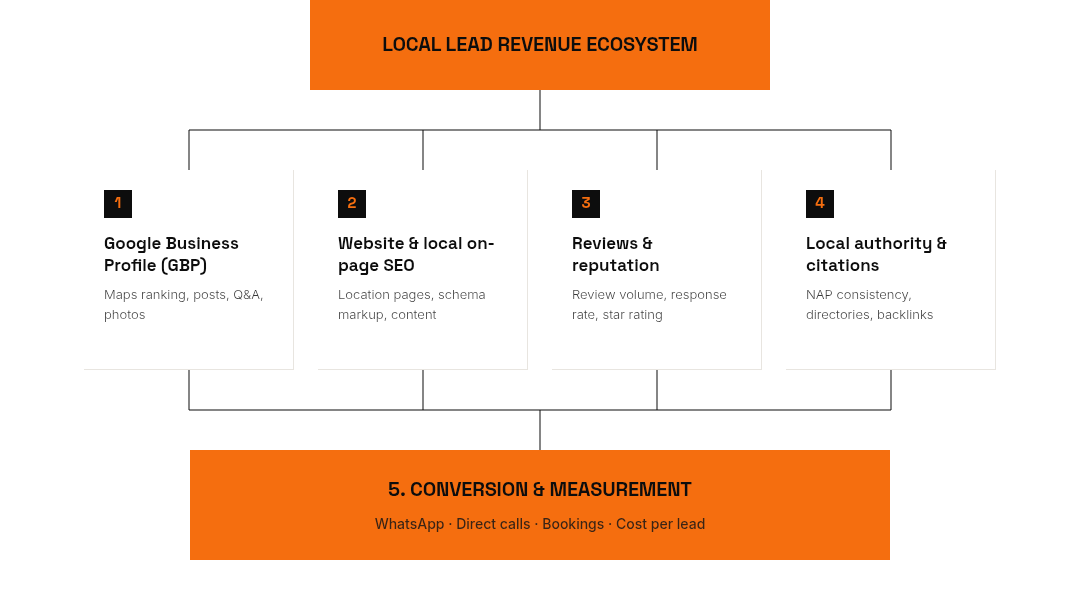
Pillar 1: Google Business Profile (GBP)
Your Google Business Profile is the front door of your local digital presence. For many service businesses, it generates more direct enquiries than the website itself.
Getting your profile right requires strict compliance with Google's core setup standards:
- Primary Category Selection: This is the single strongest relevance lever in the local algorithm. Choose the primary category that reflects your core revenue driver (e.g., "Plumber" rather than "Home Repair").
- Secondary Categories: Add specific secondary categories to capture broader queries without diluting your primary focus (e.g., "Drain Cleaning Service", "Solar Energy Equipment Supplier").
- Complete Business Data: Ensure business hours, service descriptions, offered products, and attributes are completely populated.
- High-Quality Visual Proof: Upload real photos of your team, branded vehicles, ongoing job sites, and completed installations. Stock photos decrease trust and fail to demonstrate local presence.
Pillar 2: Website & Local On-Page SEO
Your website must explicitly reinforce the signals your Google Business Profile sends to Google. If your profile claims you serve Midrand, but your website never mentions Midrand or your specific services, Google's confidence in your listing drops.
Every high-performing local website requires:
- Service-Specific Landing Pages: Dedicated pages for each core service rather than bundling everything onto one generic services page.
- Geotargeted On-Page Signals: Title tags, headings (H1, H2), and body copy that naturally incorporate your primary service and service locations.
- Structured Data (Schema Markup): Implementing Google LocalBusiness structured data documentation to programmatically communicate your legal business name, address, phone number, opening hours, and geo-coordinates to search engines.
- Mobile Performance: Fast load times and seamless mobile navigation. Over 70% of local service queries in South Africa occur on mobile devices.
Pillar 3: Reviews & Reputation Systems
Reviews are not merely a ranking factor; they are your primary conversion driver. When a customer compares three local listings on Google Maps, the business with consistent, authentic feedback almost always gets the click.
Building a review system means focusing on three metrics:
- Review Volume: The overall number of published Google reviews.
- Review Velocity: The steady, ongoing frequency of new reviews over time. Receiving fifty reviews in one week followed by six months of silence looks unnatural to Google's algorithms.
- Review Quality: Detailed reviews where clients naturally mention specific services and suburbs (e.g., "Replaced our distribution board in Bryanston within two hours").
Pillar 4: Local Authority & Citations
A citation is any online mention of your business name, address, and phone number (NAP). Historically, SEO agencies sold packages promising submissions to 500 global directories. In 2026, this approach is obsolete.
Instead, build local authority through three structured tiers:
- Tier 1 (Essential Core): Google Business Profile, Facebook Company Page, Apple Business Connect, and Bing Places.
- Tier 2 (Reputable SA Platforms): Established South African business directories such as Brabys, Snupit, and Yellow Pages South Africa, alongside verified industry registration bodies (e.g., PIRB for plumbers, ECB/SAEE for electrical contractors).
- Tier 3 (Local Authority Links): Contextual backlinks from local chambers of commerce, community newspapers, regional suppliers, and business partners. A single link from a local Gauteng industry supplier carries far more weight than fifty obscure global directory profiles.
Pillar 5: Conversion & Measurement
If your local SEO reports show rankings moving from position #8 to position #3, but your monthly enquiries remain unchanged, your strategy has failed.
Track business outcomes, not vanity metrics:
- Direct phone calls generated from Google Business Profile and website click-to-call buttons.
- Inbound WhatsApp conversations initiated from local landing pages.
- Driving direction requests on Google Maps.
- Qualified quote requests and booked service calls.
- Cost per Lead (CPL) and total revenue generated by geographic suburb.
Navigating Proximity & Address Verification in South Africa
South African service businesses frequently face complex physical address situations. Residential offices, shared commercial workshops, and gated business parks make address management tricky.
The cardinal rule of local SEO is simple: do not manufacture a physical location to manipulate local search proximity.
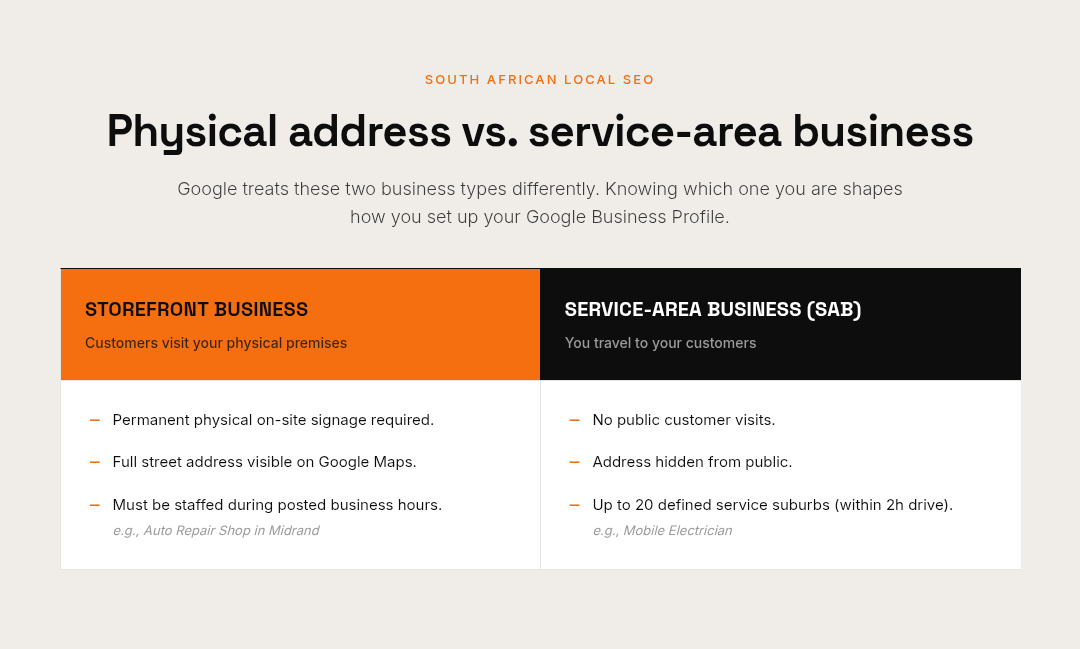
Storefront vs. Service-Area Business (SAB) Rules
Google maintains strict, distinct guidelines for storefronts versus service-area businesses:
- Storefront Businesses: If clients regularly visit your physical location (e.g., a fitment centre, dental clinic, or retail shop), you must display your full street address and maintain permanent on-site signage.
- Service-Area Businesses (SAB): If you operate from a residential home or administrative office and travel directly to client premises (e.g., an emergency plumber or mobile mechanic), you must hide your street address on your Google Business Profile. Google's official Google Business Profile service-area guidelines state that service-area businesses can select up to 20 service areas (cities, postcodes, or regions) within a maximum of two hours driving distance from where the business is based.
Creating fake physical addresses, renting virtual office mailboxes, or setting up ghost profiles across multiple suburbs violates Google's policies and risks permanent profile suspension.
Proximity is a natural ranking factor. An electrician physically based in Randburg naturally holds a proximity advantage for Randburg searches. Rather than creating ten spam listings for Sandton, Fourways, and Midrand, build one legitimate, verified business entity backed by deep geotargeted authority across all the areas you genuinely serve.
For a deeper dive into diagnosing ranking drops on Google Maps, read our detailed guide on Why Your Business Isn't Showing in the Google Map Pack (And How to Fix It).
Local Lead Conversion Architecture: Why WhatsApp is Non-Negotiable
A local search ranking without a conversion path is a vanity metric.
Consider a prospective client who searches "inverter installer near me" during load shedding. They find your listing, tap through to your mobile website, and encounter a tiny phone number, no direct messaging option, and a lengthy 10-field contact form. They will hit the back button within five seconds and call the next competitor.
In South Africa, WhatsApp is not just a messaging app. It is the core of the local sales funnel.
Building a Mobile-First Conversion Page
To convert local search demand into immediate enquiries, your mobile site layout must place conversion triggers above the fold:
- Header Zone: Clear company logo, primary service area, and prominent "Call Now" and "WhatsApp Us" action buttons.
- Hero Section: A clear value proposition addressing the immediate problem (e.g., "Emergency Plumbing Repairs in Sandton & Randburg. On Site Within 60 Minutes").
- Social Proof Strip: Live aggregate Google review rating, verified trade accreditations, and local job counts.
- Primary Service Grid: Concise bullet points detailing exact services offered, clear pricing expectations, and real local project photos.
- Direct Action Paths: Embedded WhatsApp click-to-chat links with pre-filled messages (e.g., "Hi, I need a quote for an electrical repair in Fourways").
This transforms your funnel from a slow, drop-off prone process (Google -> Website -> Form -> Wait -> Lost Client) into a real-time conversation (Google -> Website -> WhatsApp -> Quote -> Booked Job).
South African Directory Citations: What Works vs. What Waste Time
Many local agencies continue to sell outdated "citation building" packages that submit client details to hundreds of low-quality web directories. This tactic adds zero value to your local search visibility.
When evaluating local citation sources, assess three criteria:
- Does Google actively index and trust the platform?
- Is the platform locally or industry relevant to South African consumers?
- Do real human prospective clients use the directory to find service providers?
Focus your efforts on high-utility South African directories such as Brabys, Yellow Pages SA, and Snupit, alongside official industry associations (e.g., Master Builders South Africa, CIPC, or local chambers of commerce). Avoid automated mass-submission services promising hundreds of directory listings. Building ten authoritative, accurate local mentions delivers far greater strategic value than cluttering the web with unused profiles.
Common Local SEO Scams & Myths in South Africa
The local digital marketing landscape in South Africa is filled with low-cost, automated retainers that deliver reports filled with vanity numbers while failing to generate actual revenue.
The "R3,000 per Month Local SEO" Retainer
Small business owners are frequently pitched R3,000-a-month "SEO retainers". In most cases, these low-cost packages consist of automated directory submissions, generic AI-generated blog posts stuffed with keywords, and automated rank-tracker PDFs. They rarely include custom technical optimizations, conversion path enhancements, or legitimate review growth systems.
Mass-Produced Suburb "Doorway" Pages
Another common grey-hat tactic is generating dozens of identical landing pages targeting every suburb in Gauteng:
/electrician-randburg//electrician-sandton//electrician-fourways//electrician-midrand//electrician-roodepoort/
When every page shares identical copy with only the suburb name swapped, Google classifies these as doorway pages. According to Google Search Central doorway page guidelines, pages created solely to capture search traffic without offering unique, location-specific value harm user experience and incur algorithmic penalties.
If the only word that changes on your Randburg page is the word "Randburg", you do not have a local landing page. You have a doorway page.
Case Study: Building a Systematic Review Acquisition Engine
To understand how structured review acquisition impacts local search, consider an anonymised Gauteng service business that struggled with local lead volume despite providing excellent service.
The Initial Challenge
The business had operated for several years but possessed fewer than twenty Google reviews. Satisfied clients frequently expressed gratitude verbally or over WhatsApp, but the business had no formal process to capture that goodwill publicly on Google. As a result, prospective clients comparing them against competitors with sixty or seventy reviews selected the higher-rated alternatives.
The System Implementation
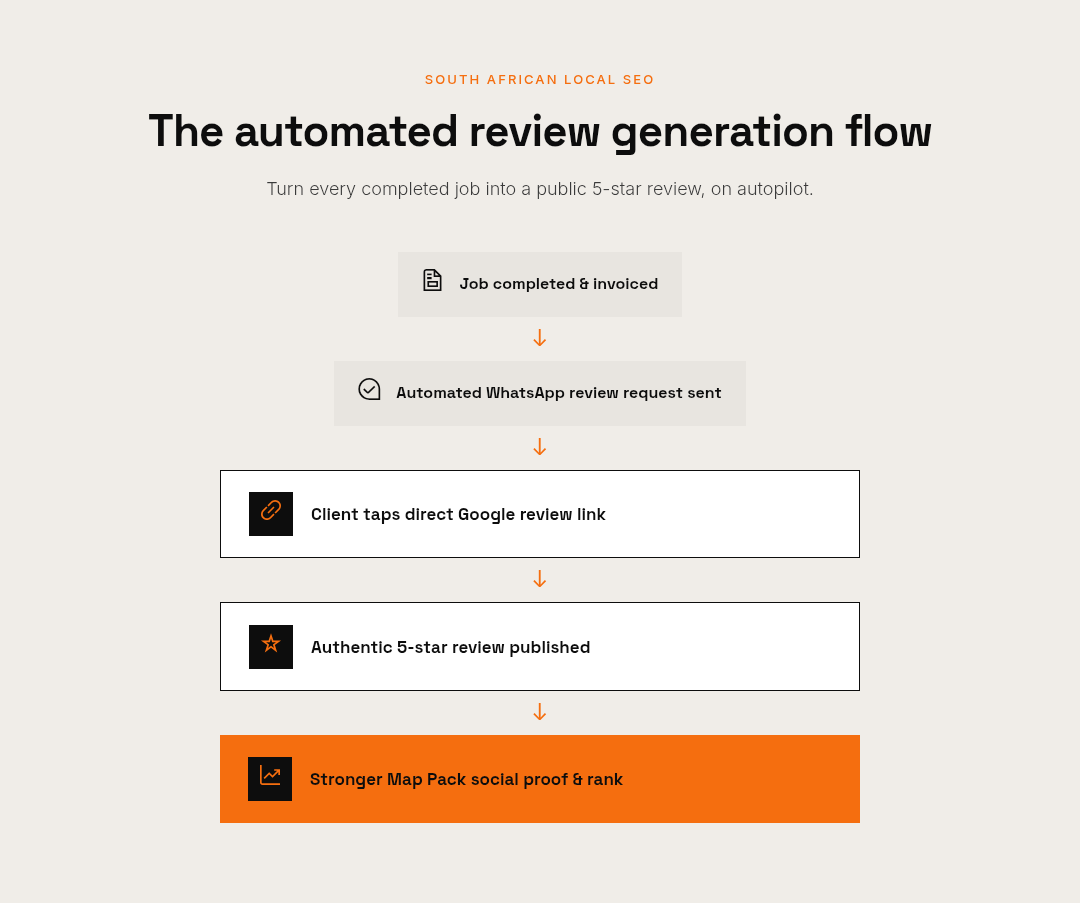
Rather than relying on ad-hoc requests, we integrated review collection directly into the post-job operational workflow:
- Job Completion Trigger: As soon as an invoice was paid and closed in their management software, an automated, personalized follow-up message was sent via WhatsApp.
- Frictionless Link: The message contained a direct Google review link, making it simple for the client to tap and leave feedback in under thirty seconds.
- Polite Follow-up: A single, courteous reminder was scheduled three days later if no review had been submitted.
The Results
Within several months, the business scaled from under 20 reviews to over 50 authentic customer reviews. More importantly, this systematic approach built a steady stream of review velocity. When local prospective clients evaluated search results, the influx of recent, detailed feedback dramatically improved profile click-through rates, driving increased inbound phone calls and website quote requests.
The key takeaway is clear: the goal was not simply to reach fifty reviews, but to build an operational system that continuously converts completed jobs into authentic public social proof.
Review Compliance & POPIA Guidelines
When collecting customer reviews, South African businesses must strictly follow both Google's policies and local POPIA regulations.
Google Review Guidelines
Google's official policy strictly prohibits incentivised reviews. According to Google's guidelines on prohibited review incentives, offering discounts, gifts, entries into competitions, or cash in exchange for reviews violates policy and can lead to review removal or profile suspension.
- Do: Ask every legitimate customer for their honest feedback using a direct review link or QR code.
- Do Not: Offer discounts, gifts, or financial incentives in exchange for reviews.
- Do Not: Selectively screen clients to only send review links to happy customers while suppressing unhappy ones (review gating).
- Do Not: Tell customers specific keywords or phrases to include in their review.
Practical POPIA Compliance
Complying with the Protection of Personal Information Act (POPIA) in your review and local marketing processes requires straightforward data hygiene:
- Use client contact details (phone numbers, email addresses) exclusively for legitimate, explicit business communications.
- Do not export customer lists into unverified third-party marketing automation platforms without proper consent.
- Ensure your website contains a clear privacy notice detailing how customer enquiry data is collected, stored, and protected.
- Immediately honour any client request to opt out of marketing communications.
Geotargeted Content Architecture: Create Pages for Markets, Not Places
When expanding your local search reach across multiple suburbs, build landing pages around genuine market demand and real business activity rather than creating empty geographic templates.
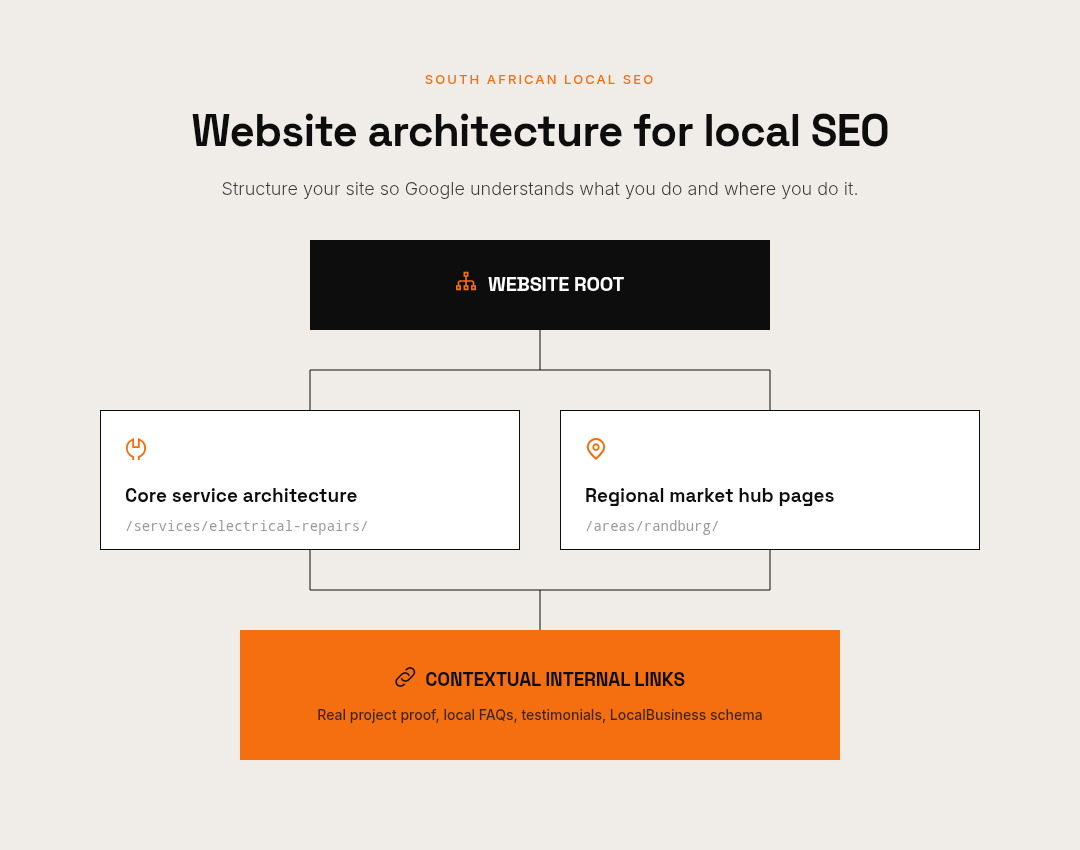
Service x Location Structure
Instead of creating dozens of thin suburb pages, structure a clean, hierarchical URL architecture:
- Core Service Hubs:
/services/electrical-installations/,/services/solar-inverter-repairs/ - Regional Market Pages:
/areas/randburg/,/areas/sandton/,/areas/centurion/
A high-performing regional market page should contain rich, unique content:
- Specific services offered in that regional market.
- Case studies or project summaries of actual work completed in that suburb.
- High-resolution photos of real local job sites.
- Genuine customer testimonials from residents or businesses in that area.
- Suburb-specific FAQs addressing local infrastructure, common property issues, or regional regulations.
By populating location pages with authentic project proof, you build legitimate local relevance that satisfies both Google's quality algorithms and human prospective clients.
Measuring What Matters: Revenue Over Vanity Metrics
To determine whether your Local SEO strategy is delivering genuine commercial return, measure metrics that directly correlate with sales:
| Metric Category | Vanity Metrics (Ignore) | Commercial Outcomes (Track) |
|---|---|---|
| Rankings | Aggregate keyword rank position | Top 3 Map Pack impressions for primary revenue terms |
| Traffic | Total raw website pageviews | Mobile click-to-call conversions & WhatsApp clicks |
| Engagement | Time on page / Bounce rate | Driving direction requests & quote submissions |
| Financial | Estimated organic search value | Cost Per Lead (CPL) & Total revenue generated by suburb |
The Local SEO Content Hub: What Comes Next
This guide serves as the master pillar page for Keno Sonic's Local SEO knowledge hub. Over the coming weeks, we will publish dedicated, in-depth spoke guides expanding on every core component covered here:
- Spoke 1: The Complete Google Business Profile Optimization Guide for SA Businesses
- Spoke 2: How to Build a POPIA-Compliant Google Review Engine
- Spoke 3: Local SEO Strategies for Plumbers, Electricians & Home Contractors
- Spoke 4: WhatsApp Conversion Optimization for Service-Based Businesses
- Spoke 5: Multi-Suburb SEO: How to Rank Across Gauteng Without Penalties
Take the First Step: Book a Free Local SEO Audit
If you are tired of paying for monthly SEO retainers that produce reports full of vanity numbers while your phone remains quiet, let us evaluate your actual local search setup.
At Keno Sonic Interactive, we build data-driven digital marketing and local search engines designed around one objective: generating measurable, high-margin revenue for South African businesses.
Our free, comprehensive Local SEO Audit evaluates your Google Business Profile completeness, local Map Pack rankings, website conversion paths, mobile UX speed, and suburb coverage against your top local competitors.
Free offer
Get a free technical audit
We'll review your site's performance, code quality, and conversion potential: no strings attached. Usually takes 48 hours.
Request your free audit →Tags
About the author
Steven Rerani
Founder
Steven is the Founder of Keno Sonic Interactive, a Johannesburg-based digital marketing agency helping South African SMEs build connected, data-driven digital strategies. He has over 11 years of experience across the SABC, Aon South Africa, and his own ventures.
Frequently asked questions
Common questions about this topic
What is the difference between general SEO and Local SEO?
General SEO focuses on ranking a website for broader national or global search terms. Local SEO optimizes your digital presence so your business appears in geographic searches, specifically targeting the Google Map Pack and location-based search results in your service area.
How long does it take to see results from Local SEO in South Africa?
Initial improvements to your Google Business Profile, such as category fixes and address adjustments, can impact local Map Pack rankings within 72 hours to 2 weeks. Comprehensive website SEO, content architecture, and authority building typically deliver compounded lead growth over 3 to 6 months.
Can a service-area business without a storefront rank on Google Maps?
Yes. Businesses that travel to clients, such as mobile electricians or plumbers, can set up a Service-Area Business (SAB) profile on Google. By hiding their residential address and defining up to 20 specific service areas within a 2-hour drive, they can rank prominently on Google Maps.
Is it legal under POPIA to ask customers for Google reviews?
Yes. Sending a direct review request to a client who recently purchased a service from your business is fully compliant with POPIA, provided you do not store or share their personal data improperly and respect any request to opt out of future communications.
How many Google reviews do I need to rank in the Map Pack?
There is no magic number. While review count matters, Google prioritizes review velocity, recency, and overall relevance. A business with 30 recent, detailed reviews will often outrank a competitor with 100 older, unoptimized reviews.
More in Search Engine Optimisation (SEO)
Dentists: How to Fill Your Appointment Book from Google
Ranking on Google is only half the job. Discover how South African dental practices turn local search visibility into booked appointments and full chairs.
Read →10 min readRoofers: Turning "Roof Repair Near Me" Searches Into Quotes
Turn 'roof repair near me' Google searches into booked roofing quotes. Discover the local SEO, WhatsApp triage, and proof architecture that wins jobs.
Read →Start your project.
CONTACTTell us about your business and what you're trying to achieve. No obligation, just a conversation to see if we're the right fit.
// We work with a small number of clients at a time. Every enquiry gets a considered response, not a template.