How Much Does a Website Cost in South Africa in 2026?
Discover realistic 2026 website design costs in South Africa. Compare pricing tiers, hidden fees, and platform choices before you hire an agency.
Author
Steven Rerani
Founder
Published
30 July 2026
Contents↓
Why do two websites that look almost identical on screen cost R8,000 from one provider and R80,000 from another?
If you are a South African small or medium business owner, you have likely asked yourself this exact question. Whether you run a plumbing business in Johannesburg, an electrical firm, a medical practice, a law firm, or a growing eCommerce brand, you already know you need a modern web presence. The challenge is that web development quotes in South Africa range from R1,500 on Facebook groups to hundreds of thousands of Rands from boutique agencies.
You are not looking for the cheapest option. You are asking a far more practical question: how much should I realistically spend to get a website that actually generates leads and sales without getting ripped off?
This guide breaks down realistic 2026 website costs in South Africa, reveals the hidden expenses agencies rarely mention upfront, and explains how to evaluate a website as a revenue-generating investment rather than an administrative expense.
2026 South African Website Pricing Tiers
Broad price ranges like "R5,000 to R100,000" are unhelpful. To build a realistic marketing budget, you need to understand what specific business requirements cost in the local market today.
Here is what realistic website development pricing looks like in South Africa for 2026:
| Website Type | Typical 2026 Price Range | Best Suited For |
|---|---|---|
| Landing Page | R3,500 to R8,000 | Targeted ad campaigns, single-service promotions |
| Basic Brochure Website (5 to 8 pages) | R8,000 to R18,000 | Early-stage service providers, simple local presences |
| Professional Business Website | R18,000 to R45,000 | Established SMEs, trade specialists, lead generation |
| WooCommerce Store | R30,000 to R80,000 | Growing retail brands, multi-category eCommerce |
| Custom Business Platform | R80,000 to R250,000+ | Booking engines, custom portals, high-volume workflows |
| SaaS / Web Application | R150,000 to R1,000,000+ | Digital product startups, enterprise automation |
What Actually Drives the Price?
When you review a web design proposal, you are not paying per page. You are paying for technical complexity and strategic execution.
A R10,000 website and a R40,000 website might both have five pages (Home, About, Services, Gallery, Contact). However, the price difference reflects what happens beneath the surface:
- Conversion Strategy & UX: Designing a clear journey that guides a prospective client from curiosity to submitting an enquiry form.
- Professional Copywriting: Crafting persuasive text that speaks directly to your prospective customer's pain points rather than pasting generic filler text.
- Technical Search Engine Optimisation (SEO): Building clean code, structured schema markup, and metadata so Google can index and rank your pages.
- Integrations: Connecting your site to CRM systems, calendar booking tools, WhatsApp business APIs, and automated email sequences.
- Performance Optimisation: Ensuring pages load instantly on mobile networks across Gauteng and the rest of South Africa.
The "R1,500 Website" Trap
Every business owner in South Africa has seen advertisements offering "Complete Websites for R1,500." It sounds like an unbeatable deal, especially for a new business watching its cash flow.
In practice, these ultra-cheap offers almost always follow the same pattern. The website looks acceptable for the first week. Then the real issues begin to surface:
- Zero SEO Foundations: The developer drops your text into a recycled template used by hundreds of other businesses. Google ignores the site completely.
- Abysmal Load Speeds: Heavy, unoptimised images cause pages to take 8 to 15 seconds to load on mobile connections.
- Broken Lead Mechanisms: Enquiry forms fail to deliver notifications, or security vulnerabilities lead to constant inbox spam.
- Ownership Hazards: The developer registers the domain name under their personal account. When you ask to move providers later, they hold your domain hostage or vanish entirely.
- Security Risks: Without regular updates, budget WordPress builds are frequently compromised by automated malware within months.
The primary danger of a R1,500 website is not the money you spend upfront. It is the invisible opportunity cost. Every week your site sits online with broken user experience and zero search visibility, prospective clients who were actively searching for your services click on your competitors instead.
Hidden Costs SA Businesses Forget to Budget For
Building the website is only the first step. A common mistake among local business owners is budgeting R20,000 for web design, but allocating R0 to keep the platform secure, fast, and operational.
To avoid unexpected financial surprises, ensure your annual digital budget includes these ongoing items:
1. Annual Base Infrastructure
- Domain Name Registration (.co.za): Expect to pay between R90 and R250 per year for standard local renewals through registrars or hosting providers.
- SSL Certificates: Essential for security and Google ranking. While many modern hosts provide free Let's Encrypt SSLs, organisation-validated certificates can cost R300 to R1,500 annually.
- Professional Email Hosting: Running your business off a free Gmail address undermines credibility. Dedicated business mailboxes (e.g. through Google Workspace) typically cost R100 to R250 per user per month.
2. Monthly Maintenance and Hosting
- Managed Web Hosting: Reliable hosting tailored for WordPress or web apps ranges from R150 to R800 per month depending on traffic and speed requirements.
- Security & Backups: Automated daily off-site backups, malware scanning, and core software updates usually require a maintenance budget of R500 to R1,500 per month.
3. Payment Gateway & Compliance Fees
If you sell products online, local payment gateways like PayFast, Yoco, Peach Payments, and Ozow do not charge massive upfront setup fees, but they take a transaction cut (typically 2.5% to 3.5% + R2.00 per sale). Furthermore, under South Africa's Protection of Personal Information Act (POPIA), your site must feature compliant privacy notices, terms of service, and cookie consent banners.
What a Lead-Focused Rebuild Looks Like in Practice
To understand why strategic web development costs more than a simple template, consider a common scenario faced by local service providers.
A South African service business invested in a low-cost website two years ago. Visually, the site appeared acceptable. However, despite spending money on local promotion, it produced virtually zero phone calls or form submissions.
When conducting a technical audit of the platform, the root causes quickly became obvious:
- Pages took over seven seconds to load on mobile devices.
- Critical phone numbers were buried inside static image banners where mobile users could not tap to call.
- Search engines could not read the page structure because basic meta tags and local location signals were missing.
- Forms lacked basic submission verification, causing prospective clients to receive error messages when attempting to request quotes.
Instead of simply applying a cosmetic facelift, the solution required rebuilding the site around the customer's buying journey. By streamlining page code, implementing structured schema for local search, optimising mobile tap targets, and placing clear conversion prompts on every page, the platform was transformed.
The result was not just an aesthetic upgrade. It turned an inactive digital brochure into a practical sales tool that generated a consistent stream of qualified local enquiries every month.
Technical Realities That Impact Web Performance in South Africa
Developing digital products for South African users requires catering to specific local infrastructure conditions. Generic international templates frequently fail in the local market because they ignore these realities.
Mobile-First Browsing
Data from DataReportal's Digital 2026 South Africa Report shows that online penetration in South Africa stands at nearly 80%, with the vast majority of users accessing the web via mobile devices. If your website is designed primarily for desktop screens and scaled down as an afterthought, you will lose most of your mobile audience.
Network Speeds and Mobile Data Costs
Mobile data remains a conscious consideration for South African consumers. Research published by Think with Google on mobile page speed indicates that as page load times stretch from one second to five seconds, the probability of a mobile visitor bouncing increases dramatically. Unoptimised video backgrounds, massive image files, and heavy JavaScript frameworks consume visitor data and cause immediate drop-offs on congested 4G connections.
Local Search Engine Optimisation (SEO)
For service businesses in Trades & Home Services (plumbers, electricians, builders) or professional services, appearing in local search results is vital. Integrating your site with your Google Business Profile, deploying location-specific landing pages, and configuring structured data markup are far more effective at driving revenue than complex aesthetic animations.
Wix vs Shopify vs WordPress vs Custom Builds
Choosing the wrong technology stack can force you to rebuild your website from scratch within twelve months. Here is an honest appraisal of the main platforms:
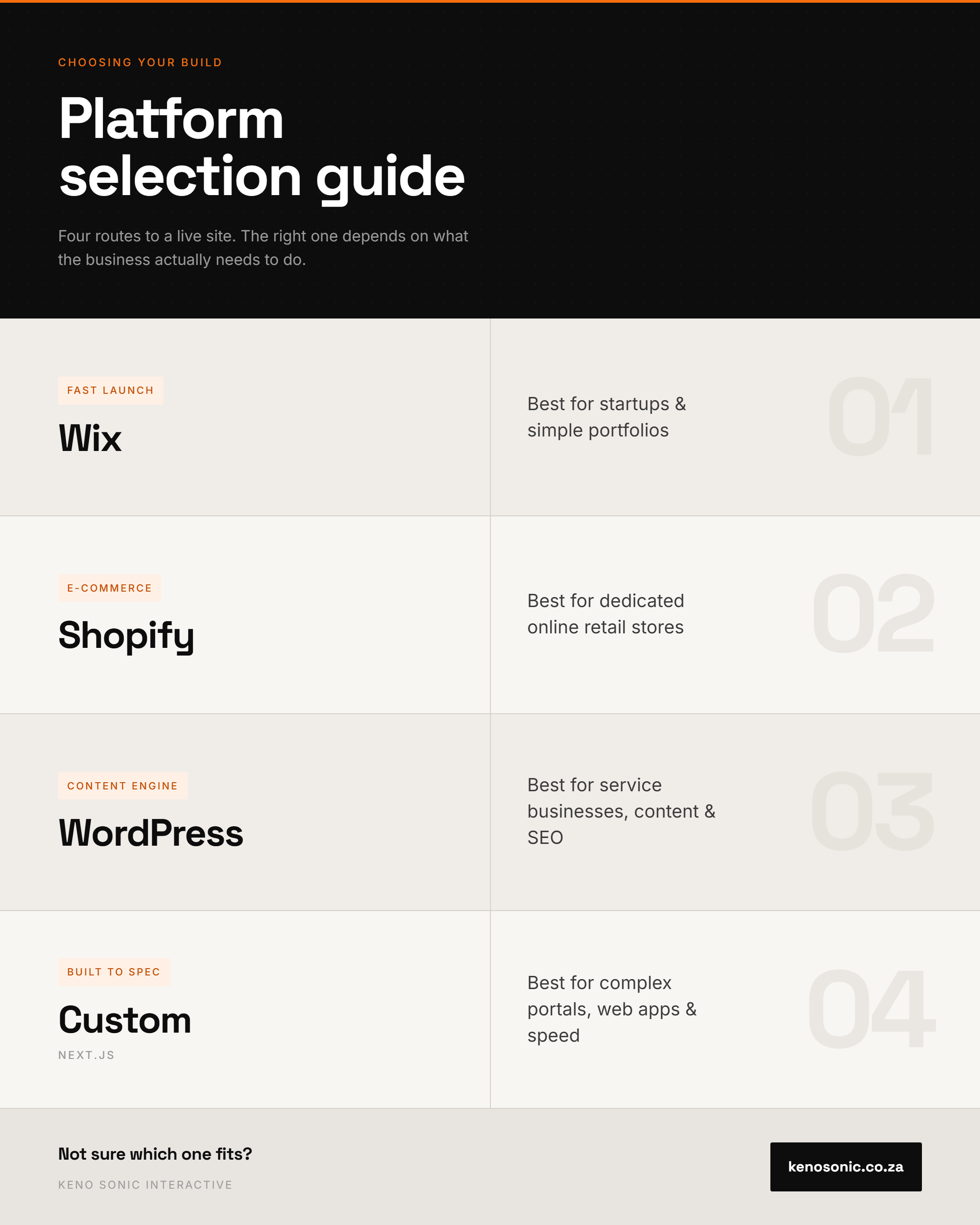
Wix
- Best for: Solopreneurs, early-stage startups, and simple portfolios testing a new business concept.
- Limitations: Becomes restrictive as your SEO demands grow, and transferring your content to another platform later is difficult.
Shopify
- Best for: Pure eCommerce and product inventory sales.
- Why it works: Shopify payment integrations like Yoco and PayFast work seamlessly out of the box. While the basic plan costs around R300 to R460 per month, utilizing promotional trial periods allows you to build and launch your store before monthly software charges apply.
WordPress
- Best for: Service businesses, content marketing, and long-term search engine growth.
- Why it works: Powers over 40% of the web. It offers complete ownership of your asset, unlimited flexibility, and robust tools for Search Engine Optimisation (SEO) and local lead generation.
Custom Builds (Next.js / React)
- Best for: Custom web applications, client portals, membership systems, and platforms requiring ultra-fast performance.
- Caution: Not every business requires a fully custom-coded web application. Many traditional agencies oversell expensive custom frameworks to client businesses that would be far better served by a well-architected WordPress build.
Upfront Investment vs Monthly Subscriptions
Should you pay for your website in one lump sum or choose a monthly package?
Both models have clear merits depending on your business stage:
- Upfront Ownership: You pay for the initial development (e.g. 50% deposit, 50% on launch) and own the digital asset outright. This approach suits established businesses with available capital who want to minimise recurring overheads.
- Monthly Subscription Packages: You pay a manageable monthly fee (e.g. R500 to R1,500/month) that covers initial setup, managed hosting, security updates, and ongoing content edits. This model works well for growing businesses looking to preserve cash flow.
A website should not be treated as a static one-off purchase. It operates much like a digital sales representative. To maintain strong results, it requires regular security updates, performance monitoring, and fresh content strategy.
The ROI Math: Viewing Your Website as an Asset
When evaluating web development quotes, reframe the figure from an expense to an investment yield.
Consider a practical comparison for a local service company:
Scenario A: The R3,000 "Digital Business Card"
- Initial Cost: R3,000
- Monthly Enquiries Generated: 0
- Annual New Revenue: R0
- Net Return on Investment: -100% (R3,000 lost)
Scenario B: The R25,000 Lead-Generating Website
- Initial Investment: R25,000
- Average Client Contract Value: R12,000
- Monthly Qualified Enquiries: 15
- Conversion Rate (20%): 3 new paying clients per month
- Monthly New Revenue Generated: R36,000
In Scenario B, the website covers its entire build cost within its first month of active operation. The cheapest option on paper frequently carries the highest long-term cost because of the business enquiries it fails to capture.
Next Steps for Your Business
If your current website is underperforming, or if you are planning a new web build for 2026, avoid rushing into vague price quotes.
Start with a clear understanding of your current technical standing. You can request a Free Website Audit with our team to review your site's mobile usability, load speed, Core Web Vitals, and local search visibility. We will provide practical, actionable recommendations to improve your online conversions whether you choose to work with us or not.
If you are ready to discuss your project, explore our Website Design & Development services or book a digital strategy session with Keno Sonic today.
Tags
About the author
Steven Rerani
Founder
Steven is the Founder of Keno Sonic Interactive, a Johannesburg-based digital marketing agency helping South African SMEs build connected, data-driven digital strategies. He has over 11 years of experience across the SABC, Aon South Africa, and his own ventures.
Frequently asked questions
Common questions about this topic
How much does a basic business website cost in South Africa in 2026?
A basic 5 to 8 page business website built professionally in South Africa typically costs between R8,000 and R18,000. This includes mobile responsiveness, basic SEO setup, and contact form integrations.
What are the monthly costs of running a website in South Africa?
Essential recurring costs include web hosting (R150 to R800 per month), domain renewals (R90 to R250 per year for .co.za), and ongoing software security maintenance (R500 to R1,500 per month).
How long does it take to build a business website?
A standard brochure or lead generation website usually takes 3 to 5 weeks from initial strategy to launch. More complex eCommerce stores or custom platforms can take 6 to 12 weeks.
Is WordPress better than Shopify for South African businesses?
Shopify is ideal for dedicated eCommerce stores selling physical products with local payment gateways. WordPress is better for service businesses focused on content marketing, SEO flexibility, and custom lead generation.
More in Website Design & Development
Traffic but No Sales? Fixing Your Online Store Conversion Leaks
Online store traffic but no sales? Find the conversion leaks costing South African Shopify and WooCommerce stores orders, stage by stage.
Read →10 min readBlack Friday 2026: Is Your Online Store Ready?
Black Friday 2026 lands on 27 November. Here's how South African online stores can fix hosting, checkout, payments and couriers before the rush.
Read →Start your project.
CONTACTTell us about your business and what you're trying to achieve. No obligation, just a conversation to see if we're the right fit.
// We work with a small number of clients at a time. Every enquiry gets a considered response, not a template.